









 |
 |
 |
 |
 |


 |
|
 |
|||||||||||||||
 |
|||||||||||||||||











 |
||||

 |
|
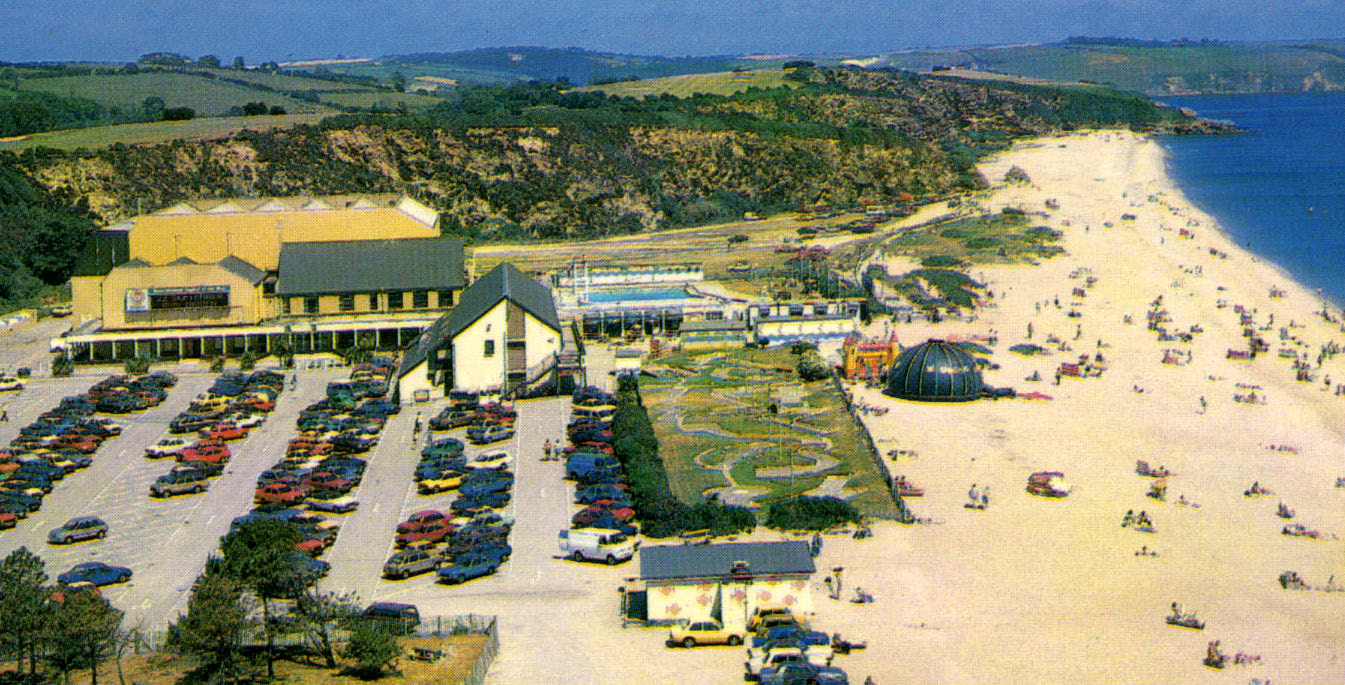
The Coliseum site on Crinnis in its heyday with swimming pool, beach activities and woodland walks on Shorthorn and Polgaver |
The current plans by Commercial Estates Group (CEG) for a development on the beaches at Carlyon Bay were passed by Cornwall Council's Strategic Planning Committee in February 2015.
The application related to the so-called "reserved matters" - that is the architects' drawings and the details of the layout and appearance of the buildings, landscaping etc,
Outline permission was given in 2011 as well as approval for the detailed plans for sea defences.
As indicated in artists' impressions shown at CEG's public exhibitions, there will be green roofs and "soft" sand dune defences on Shorthorn, with 150 units in apartment buildings and villas. This would form Phase 1 of the construction.
Phase 2 on Crinnis would see 361 residential units in blocks, with leisure facilities, retail outlets and restaurants and bars. These would be built on a platform providing an undercroft for residents' car parking.
Crinnis is the only area previously developed - but Shorthorn will be built on and even Polgaver, the last remaining natural area, is earmarked for a beach facilities building (50 sq.m), tennis courts, play area, picnic facilities, a helipad and steps.
Now that the principle of development there has been established there is little to stop more intensive use in the future.
This new permission replaces the older ones for the site which were first approved in 1990 and which the developers have, at various times, tried to revise.
THE 1989 "EXTANT" PERMISSION
- An application for the erection of 511 multi-storey holiday homes on Crinnis and Shorthorn beaches at Carlyon Bay. Permission granted on 22 October 1990.
- This permission included refurbishment and extension of the existing entertainment and leisure facilities (The Cornwall Coliseum complex). These facilities had been built originally in the 1930s and 1960s and were the only previously developed part of, and occupying only a small area of, Crinnis.
- The permission also included a vertical sea wall with rock armouring laid on a geotextile fabric. This permission was locally opposed.
- The material make-up of the beaches is, in fact, china clay waste, locally called "stent". The beach was created by the fluvial deposition of this waste material through an adit and it therefore a man-made beach. Its characteristics and behaviour is possibly unique and cannot simply be regarded as "sand". It has only been in existence for some 150 years.
(More on how the beach was formed)
1996
- Even though there was massive objection, the 1990 permission was renewed.
- An application was made again in 2001 to renew the consent but discontinued when a certificate of lawful commencement was issued by Restormel Borough Council on 13 December 2001 confirming that the development had started just before the expiry of the five-year period - this "commencement of development" was merely a few wooden pegs in the ground and some white lines, none of which can be identified today.
- No further construction of any kind of the 1990 scheme has taken place since.
2002
- An application for an alternative development of similar holiday home scale also proposed an extension of the retail and leisure facilities and included a hotel. There was again almost overwhelming opposition to this application, including the then-named Cornwall County Council, and a call for the application to be 'called in' by the Secretary of State.
- After extensive Carlyon Bay Watch research the application was eventually called in in 2004 and almost immediately withdrawn by the developer, this avoiding a public inquiry into the whole matter of the huge beach development.
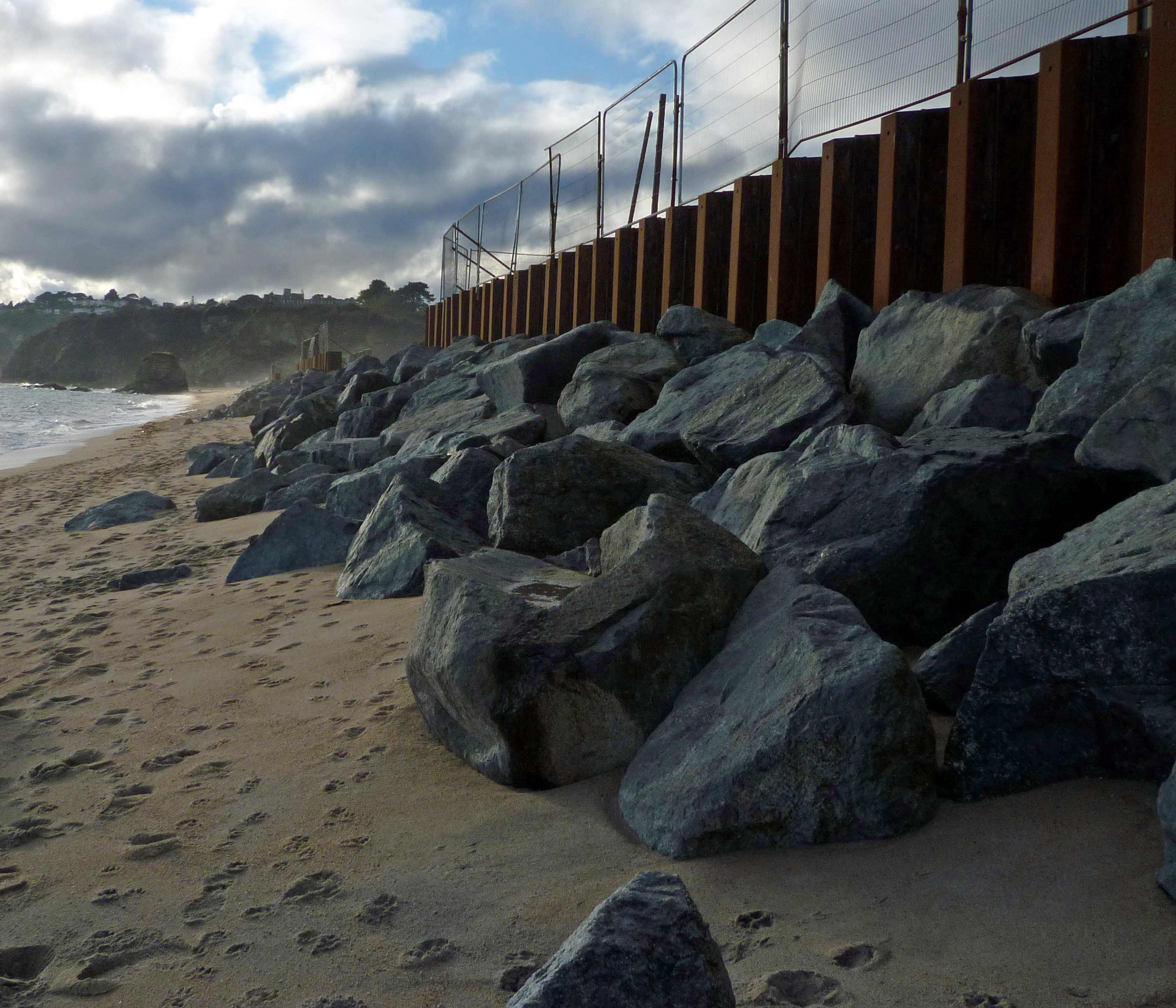 |
| The unauthorised sheet piling and rock armour cut off part of the beach at high tide |
2004
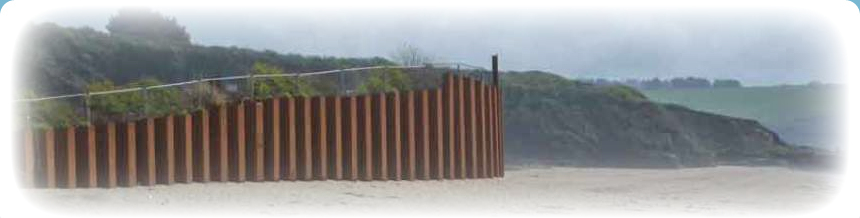
- The developer, then named The Ampersand Group Ltd., constructed, without planning permission, a line of metal shuttering out into the tidal zone, blocking access to the beach. They claimed it was merely a temporary defence for its workers.
- After considerable pressure on the local planning authority by CBW, Ampersand was forced to make a further application in January 2005 for a revision of the design and location of the sea wall, not as designed for the 1990 consent. This new application included placing beach replenishment and recharge as part of the flood protection.
2006
- The application was called in and a full Public Inquiry was held between 7 November and 8 December 2006. The Inspector was Mr JI McPherson who produced a 151-page report on 26 March 2007. This examined the issues surrounding this development.
- It heard that this new application for the sea wall was intrinsic to the abandoned 2002 scheme. By this time, the developer's experts, H.R. Wallingfords, had already advised them that the 1990 sea wall design was "dangerous to life and property". Although Ampersand were aware of this advice, this information was not make public until almost the end of the Inquiry.
- The application was supported at the Public Inquiry by the local planning authority, Restormel Borough Council. Objectors included Cornwall County Council, the Environment Agency and Carlyon Bay Watch. (The individual planning officers for Restormel throughout this process are now senior planning officers at the new unitary authority, Cornwall Council).
- The Inquiry also discussed a number of issues, including safety, sustainability, ecology, traffic management and so on and the application was eventually refused because it conflicted with various government policies (more detail on why the application was refused).
(Find Carlyon Bay on Google Maps)






For general enquiries email Carlyonbaywatch@aol.com




