









 |
 |
 |
 |
 |


 |
|
 |
|||||||||||||||
 |
|||||||||||||||||











 |
||||

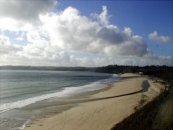 |
| The beaches at Carlyon Bay before the bulldozers moved in in 2004 |
The three beaches at Carlyon Bay are a relatively recent addition to the coastline, having been formed over the last century or so as a consequence of the mining operations in the St Austell area.
The 'sand' on the beaches is gravelly quartz, coarse sand and other minerals washed down by river from the tin and later china clay workings.
The beaches began forming in the 19th century after a tunnel was built under the cliffs into Shorthorn Bay to take the Sandy River and its load of waste away from Par where the harbour was silting up.
As retired geologist Colin Bristow points out , up until 1835 when the tunnel was completed, the high tide reached the foot of the cliffs at Carlyon Bay and there was only a narrow strip of sand at low tide.
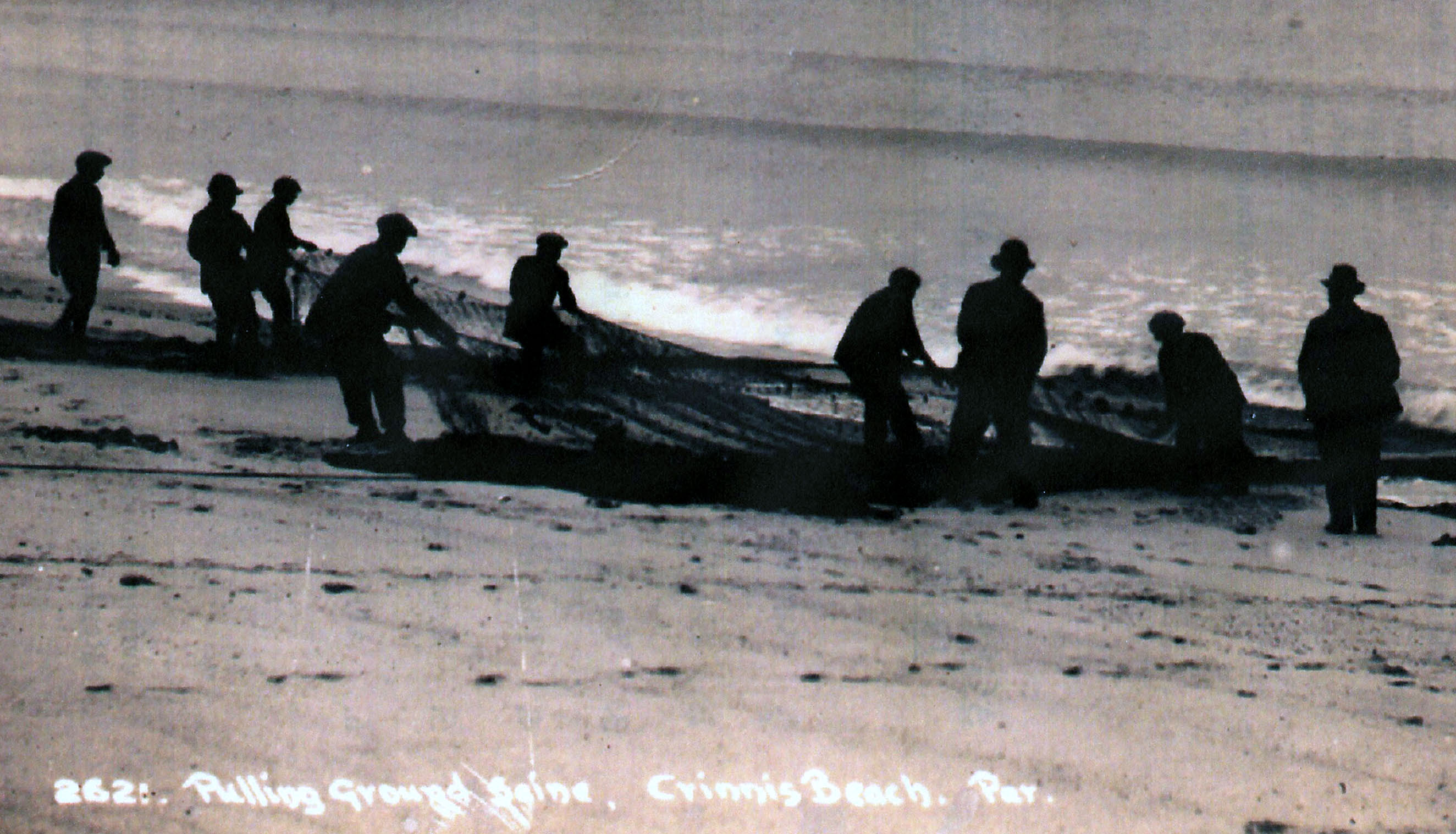 As the beaches built up, they soon became places of recreation and fishing. One of the best known Cornishmen of the 20th century was A.L. Rowse, born near St Austell in 1903 and whose father was a china clay worker.
In the first volume of his autobiography "A Cornish Childhood", he describes family outings and picnics to Crinnis Beach and relates how he was there on August Bank Holiday in 1914 when word went round that war was about to be declared and people began "gloomily" to pick up their things and go home.
START OF RIVIERA CLUB
After the First World War, during the 1920s beach huts and a cafeteria were erected on Crinnis.
Later, in the 1930s, the then Prince of Wales and Mrs Wallis Simpson were regular visitors to what is now the Carlyon Bay Hotel overlooking the beach. The Prince suggested to a group of local businessmen that an up-market sports club should be built on the beach and the famous architect Louis de Soissons was commissioned to draw up plans.
Work began on a clubhouse and an Olympic-sized swimming pool and the unfinished building was opened in 1936. The rich and famous used the Riviera Club's indoor tennis courts and the swimming pool and gathered at afternoon tea parties often, it is said, attended by the Prince and Mrs Simpson.
But the scheme was never finished. The Prince became King Edward V111 and then chose to abdicate and he and Mrs Simpson went into exile.
Then with the outbreak of the Second World War the beaches were used by the military, with the extension of Beach Road to Crinnis constructed by the U.S Army. The hotel was used by evacuees from the south east - including the boys from Canterbury Cathedral choir.
CORNWALL COLISEUM
 |
|
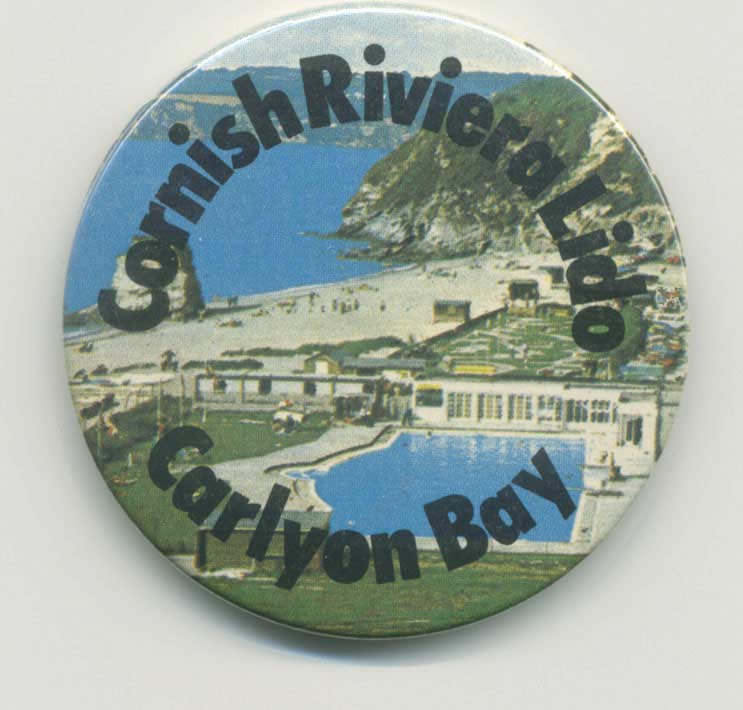
A souvenir badge from the Carlyon Bay complex |
By 1960 the Riviera Club had become a 2,620-seat concert venue (the Cornwall Coliseum) and the complex was known as Cornish Leisure World.
The magnificent pool was still in use with other attractions such as a narrow guage railway, Crazy Golf, a lounge bar, ballroom and restaurant, a rollerdrome and a nightclub.
The Coliseum hosted some of the biggest names in the music world during the 1970s and 1980s - including the Jam, Andy Williams, Madness, The Clash, Don McLean, The Who, Cliff Richard and Ultravox. It was also used for exhibitions and Championship tennis. But with the opening of a new concert venue in Plymouth, the big names no longer came to the Coliseum and its fortunes gradually declined.
Find out more on how the beaches were formed.
PLANNING HISTORY
From the 1950s when the Ministry of Housing and Local Government dismissed an appeal against a refusal to allow the creation of a small ( 20 vans ) caravan site to proposals to build 100 self-catering units in the early 1980s, Crinnis beach has been under threat from developers.
By 1987 a holiday village was being proposed which received approval but was never built.
Then in 1989 came the proposal to erect 511 holiday dwellings with refurbishment and extension to the Coliseum which received approval in 1990.
In 2002 the developer proposed to revise that 'extant scheme' so a hotel and shops could be included.
In 2004 the government agreed to hold a Public Inquiry, but almost immediately the plans were withdrawn by the developer, thus avoiding an inquiry into the whole matter of the development. A public statement had been made by the Chairman of Restormel Council's Development Control Committee that "if the ‘extant consent' were to be proposed today, it would not be approved".
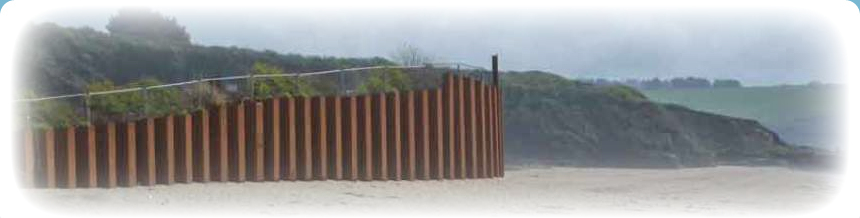
In February 2004 access to the beach was blocked and the sea wall shuttering and rock armour was constructed, without consent, much closer into the tidal zone than the 1990 scheme. (This work also meant all the trees and bushes which made Shorthorn such a varied place to explore were destroyed - our Habitat page looks at this in more detail.) The developer claimed that it was merely a temporary defence for its workers.
After considerable pressure from Carlyon Bay Watch the developer eventually submitted a planning application for a revised sea wall.
This led to the public inquiry held in November and December 2006 which resulted in the Secretary of State refusing the application - that decision was the subject of an appeal in the courts by Ampersand which was postponed again and again and now seems to have been overtaken by events.
A new planning application was submitted to Cornwall Council (March 2011) and was granted in June 2011.





For general enquiries email Carlyonbaywatch@aol.com




