









 |
 |
 |
 |
 |


 |
|
 |
|||||||||||||||
 |
|||||||||||||||||











 |
||||||

 bbb bbb |
|
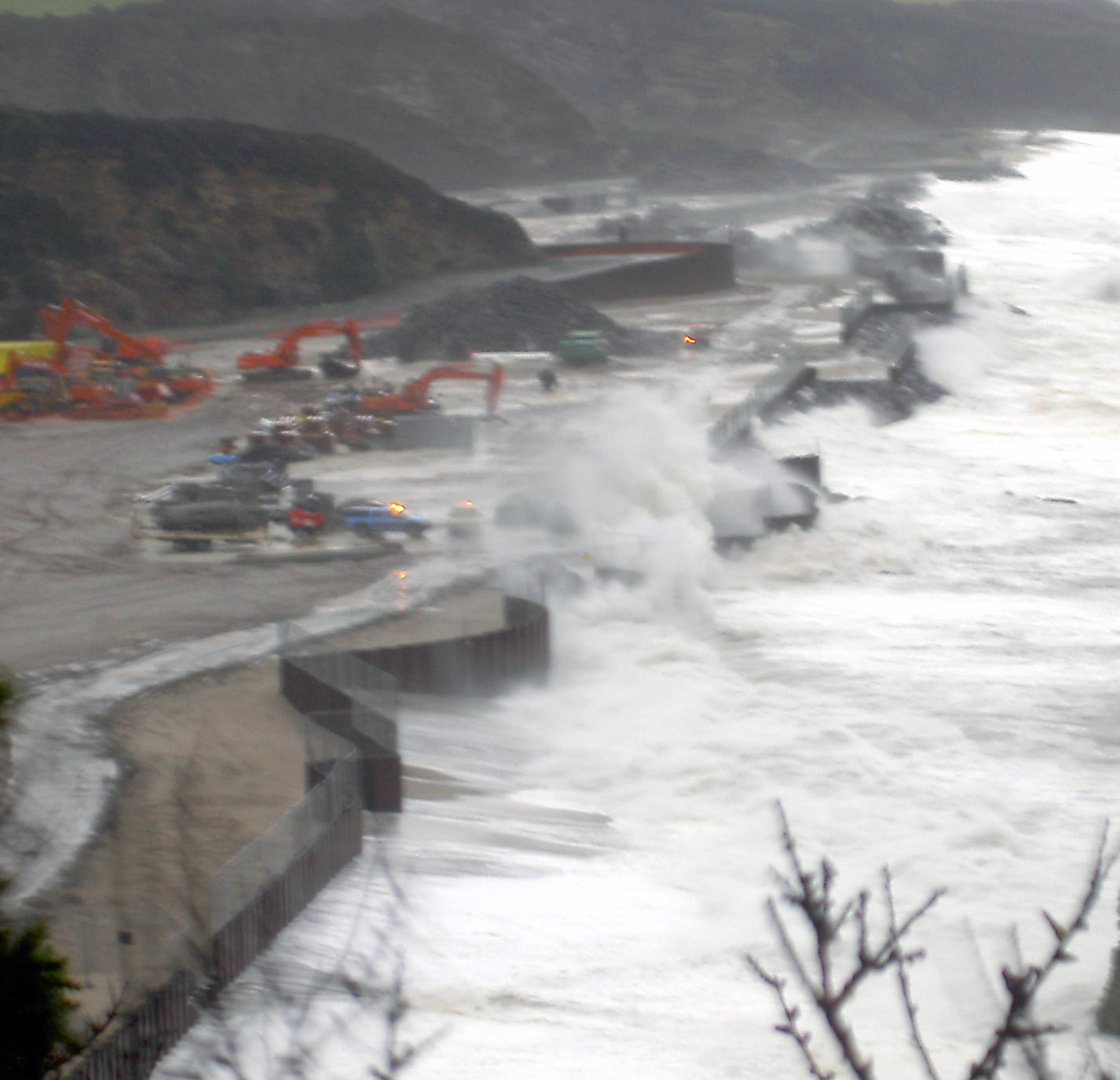
A severe storm in October 2004 washed away |
If it is accepted that the sea wall was not breached during a storm, is it possible that the resulting overtopping by huge waves and any rainfall could be trapped behind the sea wall leading to flooding of the residential area? The sea wall would then become a dam.
Oceanographer Dr Michael Fennessy, who advised Carlyon Bay Watch on aspects of the scheme, believes this is possible. In his written evidence to the Public Inquiry he stated: "The advice by engineers to now include a cautious Beach and Seawall Management Manual is indicative of the potential instability of the proposed development. If the measures advised following any of the projected failures of the sea wall or beach system were not able to be actioned rapidly during a prolonged storm (not unknown in the history of weather events) then the consequences for property and human life would be severe. Because of the increase in public concern over aspects of flooding and the demand for accountability and compensation the Carlyon Bay development is a high risk project. If this was a largely uninhabited development the risks might be acceptable, but because the population in a
physically confined area may be in excess of 1000, the risks are high."
EVACUATION PLANS
Waves crashing over the rocks and shuttering
The developer had said during the inquiry that "walls would be designed to resist the overtopping wave forces and the windows would be provided with laminated glass and storm shutters in order to prevent damage". Evidence was also given by Ampersand that if a particularly severe storm was forecast, then the site might have to be evacuated. At the very least, storm shutters would have to be secured and the promenade cleared - not a very reassuring or attractive scenario for the holiday makers in CBW's view.
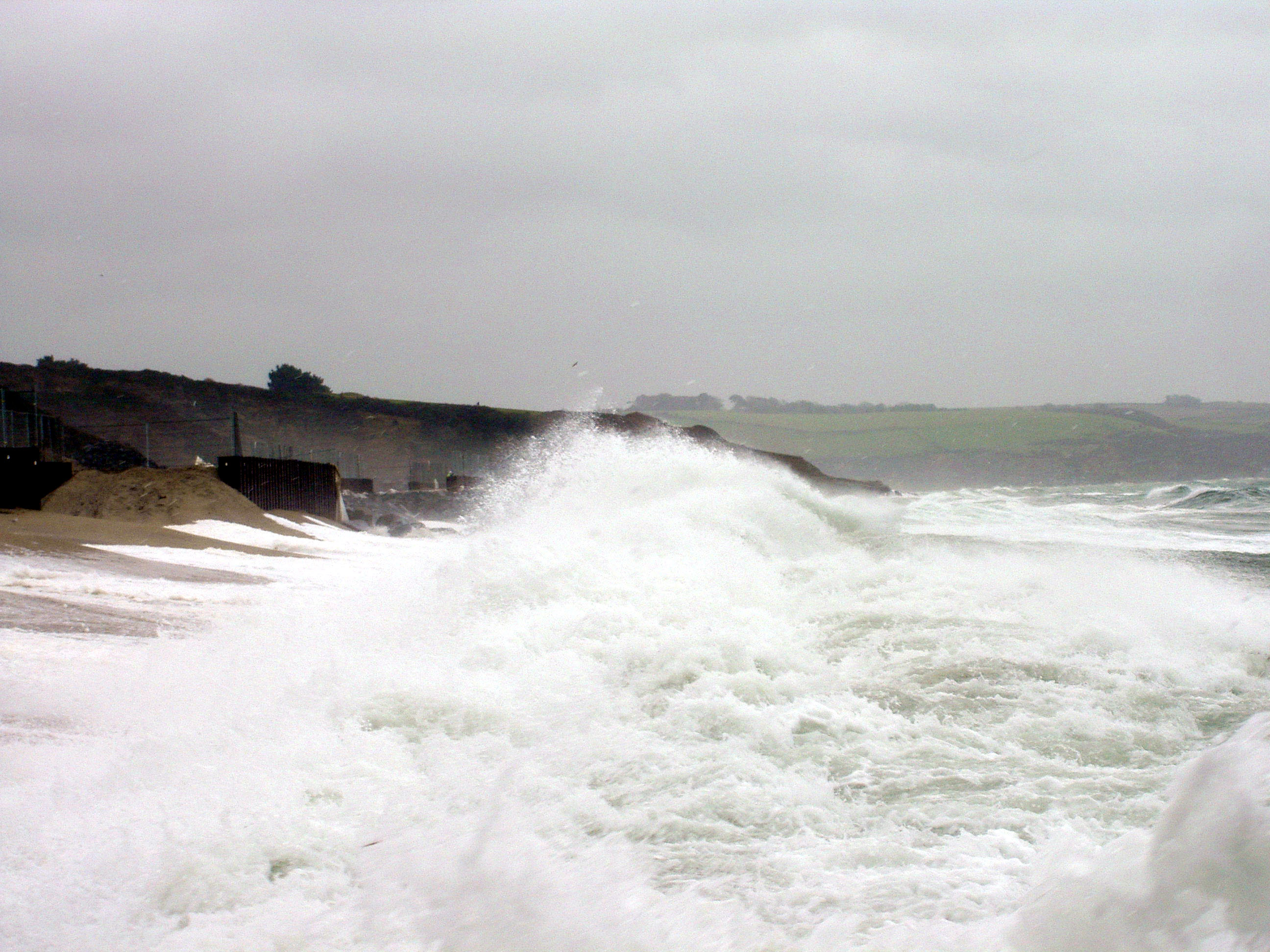
during the 2004 storm
The developer also argued that the storm warning system would give ample notice of a big storm and that those holiday makers in the most vulnerable apartments on Shorthorn would be moved to safety. As the Inspector pointed out in his report "that would rely on the accuracy of the warning system and on the staff's response to the warning, neither of which are in my view guaranteed".
He went on: "In the worst scenario, the applicants envisaged that they could evacuate the limited number of people in vehicles driven by their on-site trained staff. The overtopping rates appear to be in the range that would make that possible, but in such a situation, I very much doubt if the other people at lower risk would be prepared to sit and wait for the storm. They would be very likely to try to escape themselves, causing chaos on this link road and probably on the part of Beach Road which acts as the site access."
Another aspect of this which was discussed during the Public Inquiry was the "cry wolf" scenario. As the Environment Agency pointed out to the Inspector, weather forecasts are not always accurate. Even when a storm is predicted, its precise course cannot always be foreseen. A storm gathering in the west for instance, might pass by Carlyon Bay or might veer at the last minute and head straight for it. In those sorts of circumstances, when do you give the order to close the promenade, stop people entering the site or if necessary to evacuate? If the storm fails to materialise, when will people stop heeding future warnings?
The section washed away
In April 2005, after Ampersand had put in a planning application for the revised sea wall, but before the Public Inquiry was held, the Environment Agency wrote to Restormel Borough Council saying that it was concerned that the proposed sea defences were not good enough to withstand violent storms. The Agency's Mike Robins was then interviewed by Radio Cornwall. He reiterated the concerns: "Overwhelmingly scientific opinion is that we're going to see a change in climate patterns and certainly we're expecting significant flood risk associated with those changing climate patterns. Storminess on this coast is going to have a much bigger effect than perhaps some other areas around the country and we're looking at the perhaps one in 200-year event being maybe a one in ten-year event in 80 to 100 years' time. That means a much more likely storm event, something we'll see the likes of much more often than we do now."
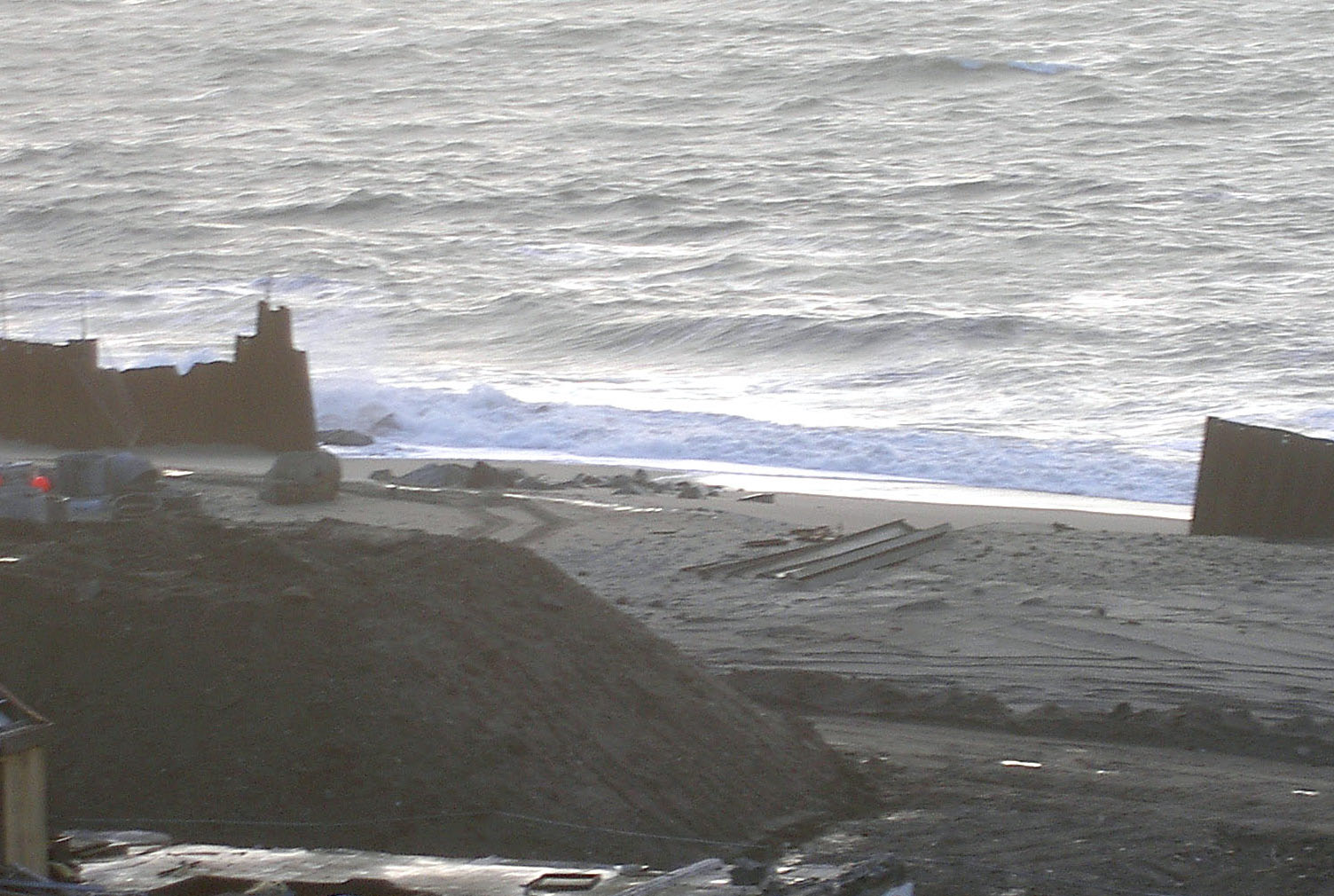
during the 2004 storm
So it is not just Carlyon Bay Watch which is raising concerns about the threat to the development from extreme weather (and we seem to have been seeing more extreme weather in recent years). The Environment Agency talks of the increased threat from storms on this south coast of Cornwall with the most violent ones occurring more frequently. Ampersand say their new proposed sea wall (turned down by the government following the Public Inquiry and now the subject of an appeal) will withstand a one in 200-year event. But, as the Agency points out, that sort of storm could now happen much more frequently. It doesn't automatically mean the wall would fail, but frequent extreme storms might mean it would not provide enough protection in the long term.
As for Ampersand's reassurances that evacuation procedures would be put in place, Dr Fennessy points out the dangers of trying to evacuate hundreds of people (perhaps in the dark and in stormy conditions) from a confined area with the sea on one side and the cliffs on the other. The Government Inspector himself sees such an evacuation likely to cause "chaos" on the sole access road. (Former English China Clays chief geologist Dr Alan Francis believes there is "potential for disaster in the plans and former Chief Engineer Cornwall Flood Defence for the National Rivers Authority is totally opposed to any residential development on the beach.)
As Dr Fennessy says - this development is "high risk" - an image in marked contrast to the drawings of a sunlit promenade and blue skies.
OTHER AREAS AT RISK OF FLOOD
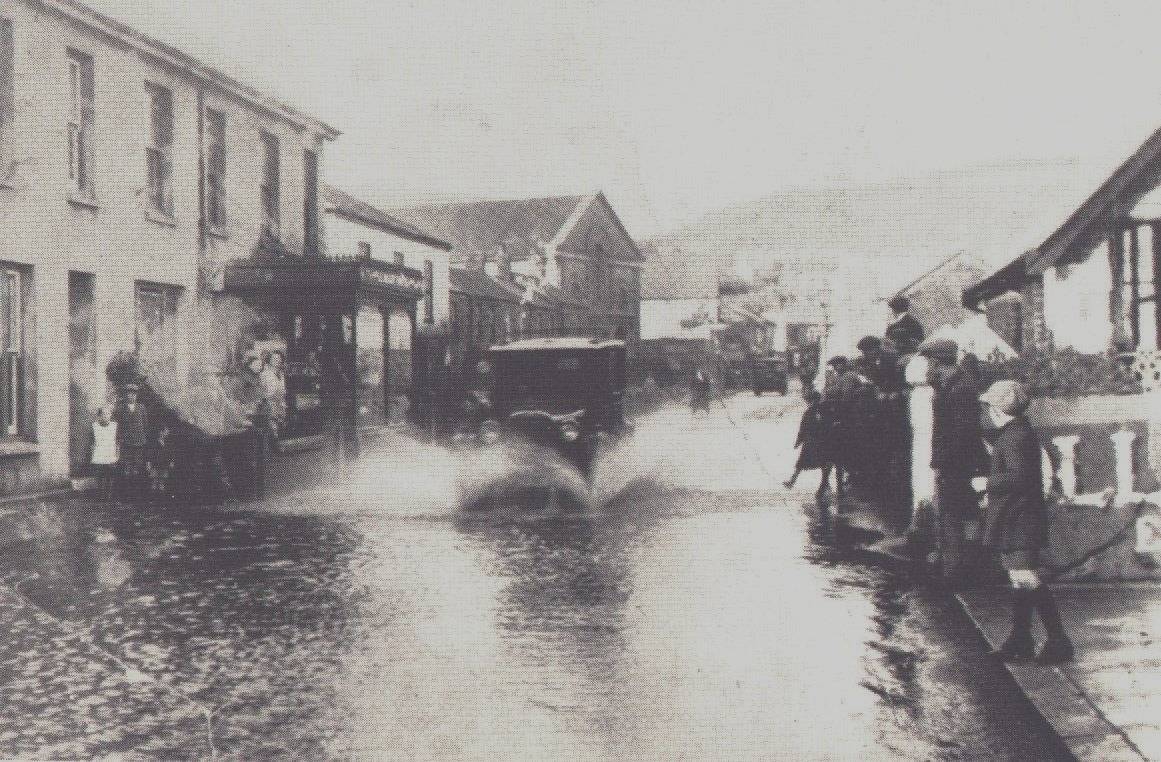
This picture taken in Par in 1928 shows the area behind the Par estuary has always been prone to flooding.
On its website, the Environment Agency produces detailed maps denoting "High Risk" and "Medium/low risk" flood zones. Even without taking into account the proposed sea defences across Carlyon Bay the following areas are designated "High Risk":
Bethel, Holmbush, Boscundle, Cuddra Plantation, Britannia Inn, Tregehan. Carvear, Mid-Cornwall Business Park, Cypress Avenue, Imerys Laboratories, Crinnis and Shorthorn beaches, Wyevale Centre, Par Docks, Lower Par Lane, St Blazey Road, Par Running Track and playing fields, Par Beach caravan park, Par Station, Pontsmill and Treesmill. The A390 would be cut between Kittows Corner and the level crossing at St Blazey.
Little attention has been paid to the probability that the construction of the nearly one-mile long sea defences will substantially alter the direction of tidal surges in this area of Carlyon Bay. At spring tides in storm conditions, tidal surges and wave patterns have been known to shift huge quantities of sand to and from Crinnis, Shorthorn and Polgaver. Par Harbour has for decades required constant dredging, largely for this reason, but the fear is that if the churn action on the waves caused by the sea wall scour out the sand in the manner predicted in one of the expert reports presented to the Inquiry, then it almost certainly must move eastward into the Par estuary.
This means that the resultant build-up of the sea bed around the estuary mouth will enable even a low-level storm surge to travel quickly into some of the High Risk areas designated above, since they are all directly connected to the Par estuary.





For general enquiries email Carlyonbaywatch@aol.com




